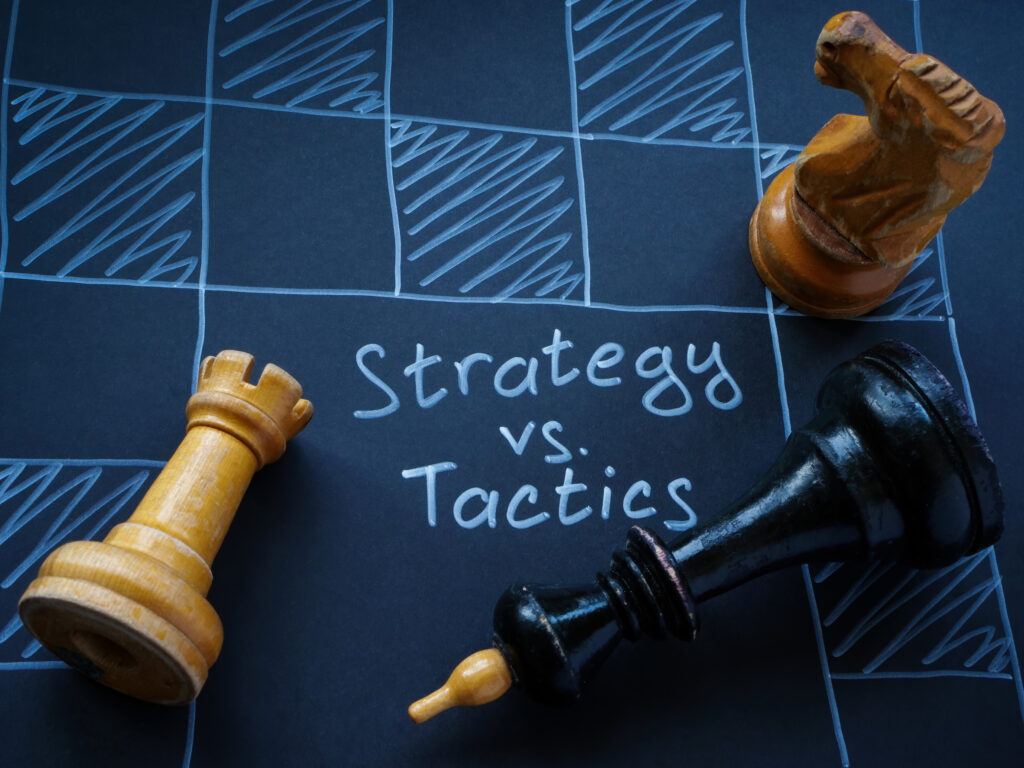
Ask any leadership team about their business strategy, and they will likely provide a list of projects, target markets, or long-term plans. Ask again in six months, and they might give a completely different set of responses.
The root issue? Many companies confuse strategy with tactics, treating them as interchangeable terms. Instead, they serve completely different purposes. This confusion leads to insufficient planning, misaligned execution, and long-term goals that fizzle out. Understanding the difference is a necessity for organizations that want to grow sustainably.
Strategy Comes First
Strategy is the overarching roadmap that guides a company toward long-term goals and answers big-picture questions. A good strategy doesn’t start with brainstorming sessions or marketing calendars. It starts with a clear understanding of what’s working, what’s not, and what hurdles need to be overcome. Without careful analysis, strategy is nothing more than random pins placed on a blank map.
Often, a detailed map with clearly identified destinations leads to a multi-year journey. It informs major business decisions, resource allocation, and the sequence in which efforts should roll out. For example:
-
Strategy 1: Expand into a new market.
Target mid-sized manufacturers to diversify revenue streams and reduce dependency on existing markets.
-
Strategy 2: Improve operational efficiency.
Streamline processes to improve efficiency, reduce costs, and increase profitability.
-
Strategy 3: Launch new products or services.
Develop new offerings that meet emerging customer needs and capture untapped demand.
-
Strategy 4: Become a digital-first organization.
Invest in digital transformation to become more agile, data-driven, and competitive.
Each of these strategies sets direction for years, not months. To succeed, they require careful planning and enterprise-wide buy-in.
Tactics Are the Tools
Strategy sets the course, but tactics move the vehicle. These are the specific actions that support the larger strategy. Tactics are usually shorter in scope, can change quickly based on results or conditions, and are sometimes experimental.
Examples of tactics include:
-
Strategy 1: Expand into a new market.
Target mid-sized manufacturers to diversify revenue streams and reduce dependency on existing markets.
- Tactics: Runs a LinkedIn ad campaign aimed at operations leaders, sponsor a session at an industry tradeshow, and leverage case studies tailored to mid-size manufacturers in the sales process.
-
Strategy 2: Improve operational efficiency.
Streamline processes to improve efficiency, reduce costs, and increase profitability.
- Tactics: Implement new project management software, provide employee training on process improvement, and outsource low-value or highly specialized tasks to free up internal resources.
-
Strategy 3: Launch new products or services.
Develop new offerings that meet emerging customer needs and capture untapped demand.
- Tactics: Conduct customer research to identify demand, launch teaser campaigns to build interest, and equip sales managers with tailored pitch decks and pilot program options.
-
Strategy 4: Become a digital-first organization.
Invest in digital transformation to become more agile, data-driven, and competitive.
- Tactics: Upgrade the CRM platform, develop a mobile-friendly website and customer app, and automate reporting dashboards to enable faster decision-making.
Tactics should always point toward strategy goals. When they don’t, teams can waste time and resources chasing key performance indicators (KPIs) that look good in a report but don’t serve long-term objectives.
The Problem With Confusing the Two
The line between strategy and tactics gets blurred more often than people realize. It usually happens when teams jump straight into action without taking time to assess where the company currently stands.
To identify a mix-up between strategy and tactics, watch for these red flags:
-
Launching initiatives without a plan.
Teams may roll out campaigns or projects without a clear connection to strategies and goals.
-
Changing direction frequently.
Leaders may pivot every quarter in response to short-term trends instead of building long-term momentum.
-
Focusing on vanity metrics.
Organizations may celebrate clicks, impressions, or likes while failing to move the business closer to meaningful outcomes.
Tactical wins can create a false sense of progress, masking the fact that the organization lacks strategic direction. When strategy is missing, tactics fill the void. That can keep people busy, but not necessarily productive or effective.
How to Fix the Disconnect
Clarifying strategy means putting the right thinking first. A simple shift to consider during each planning cycle is to start by asking, “What are we actually trying to solve?” rather than “What should we do next?”
Once decision-makers identify the challenges and establish goals, they’re better positioned to make smart decisions about which tactics will get them there. Here are a few practical tips to keep strategy and tactics aligned:
-
Separate planning sessions.
Hold strategy meetings to define goals and constraints and reserve tactical brainstorming for later, after the direction is clear.
-
Evaluate each idea carefully.
For every proposed strategy, ask, “Does this directly support our long-term direction?” For proposed tactic, ask, “Does this support the related strategy?”
-
Keep strategy stable.
Tactics can (and sometimes should) shift frequently but avoid frequent pivots in strategic direction.
Get Clarity, Then Get Moving

Strong strategy gives everyone clarity. It helps teams focus their energy and choose tactics that keep the company moving toward its goals. Tactics, in turn, bring that strategy to life, and when they’re aligned, results follow.
Before any business planning strategy or initiative launch, company leaders can ask themselves, “Is this a strategy we’re following, or just another tactic we’re trying?” That one question could save the company months—or years—of spinning its wheels.